
Total hip replacement
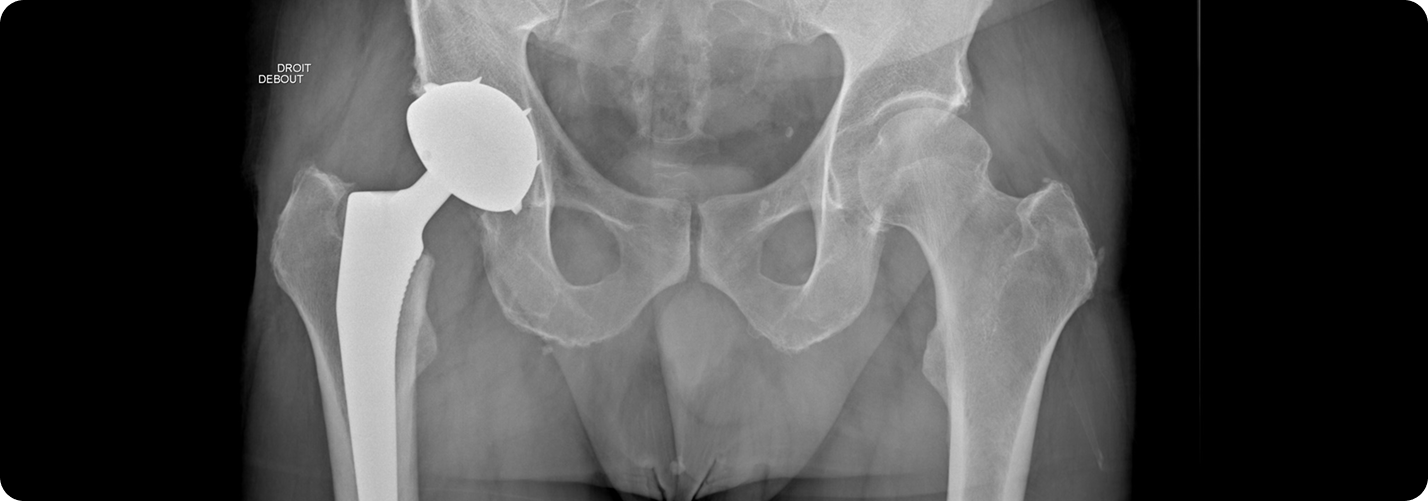
Total hip replacement is a very common surgical procedure aimed at replacing the damaged or worn-out hip joint with an artificial prosthesis. More than 150,000 implants are performed in France each year.
In the vast majority of cases, it allows for a significant improvement in pain and function.
Total hip replacement
Total hip replacement is a very common surgical procedure aimed at replacing the damaged or worn-out hip joint with an artificial prosthesis. More than 150,000 implants are performed in France each year.
Its results are regularly excellent and help relieve the suffering of many patients, but this procedure must be understood and accepted in the light of its balance of benefits and risks.
When is this surgery necessary?
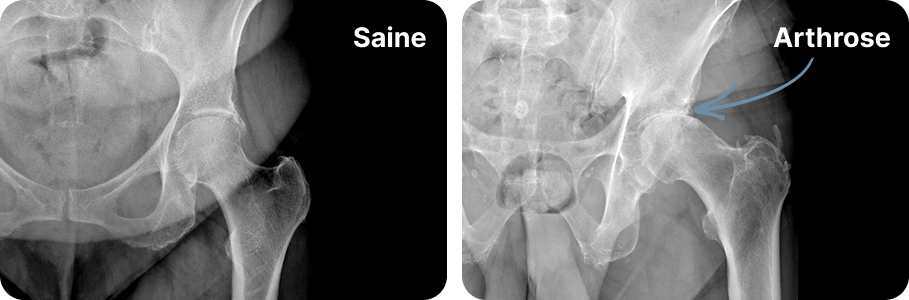
The placement of a total hip prosthesis can be proposed when the deterioration of the coxofemoral joint causes significant pain and functional limitation despite appropriate medical treatment.
This results in pain and/or deformity, most often caused by osteoarthritis (linked to age, dysplasia, deformities, and traumatic sequelae). Initially, the symptoms can be treated medically (analgesics, anti-inflammatories, infiltrations, etc.) and with physiotherapy. Radiographically, osteoarthritis is characterized by the disappearance of the articular cartilage, resulting in direct bone contact between the femoral head and the base of the coccyx.
If this is not enough, the placement of a total hip replacement is considered.
A prosthesis may also be necessary due to necrosis of the femoral head or rheumatoid arthritis.
What does the operation consist of?
A biological, radiographic, dental and urinary examination is prescribed before the operation to confirm the diagnosis and check for the absence of any concurrent infection.
The surgery is performed under general or spinal anesthesia and lasts between one and two hours. The implantation of a total hip replacement can be performed via an anterior, superior, or posterior approach to the hip. In all cases, minimal muscle disruption is sought, and the scar length varies from 7 to 15 cm depending on the case.
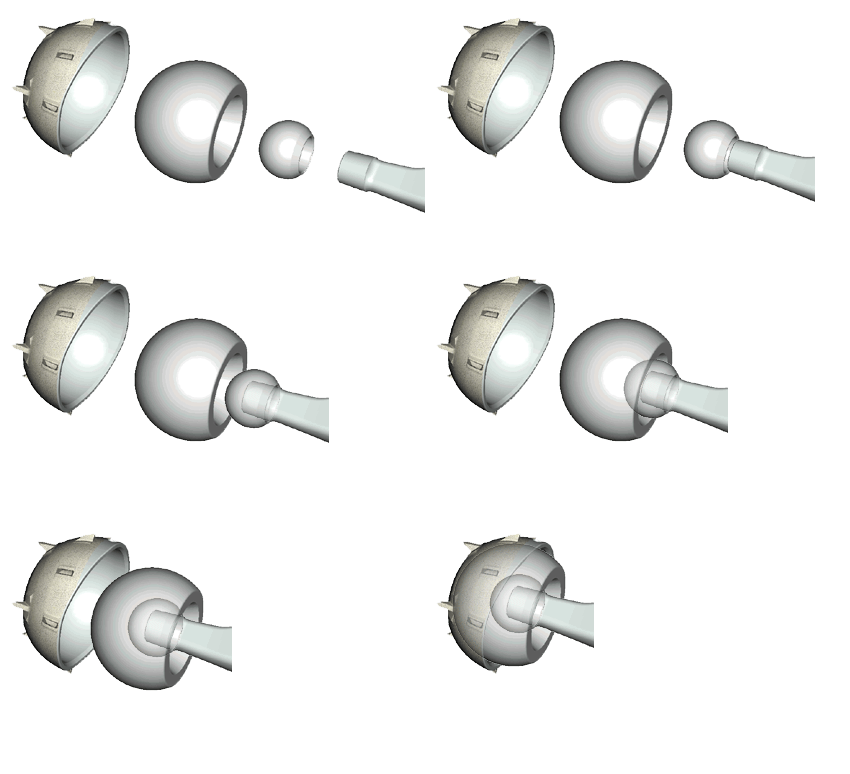
After sectioning the femoral neck, the bony acetabulum is prepared to receive a metal cup (made of cobalt-chromium or titanium) and the femur is reamed to implant a stem (made of titanium) upon which a head (most often ceramic) articulates with the insert placed inside the cup (made of polyethylene or ceramic).
Different models of total hip replacements can be implanted, depending on the patient's choice and the surgeon's advice. These prostheses are distinguished by three criteria:
The fixation
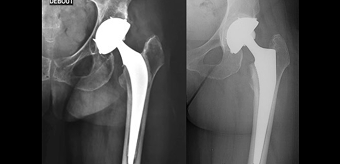
Depending on the patient’s bone condition, the prosthesis can be fixed with surgical cement or without it, in a biological manner, through close contact between the prosthesis and the bone, the option most often used.
The friction surface
The friction surface between the femoral head and the acetabular cup can vary. Each combination has advantages as well as disadvantages. It is common to combine a metal or ceramic head with a synthetic plastic acetabular insert (polyethylene). Newer polyethylene materials, known as highly cross-linked, have improved wear rates. It is also possible to combine a ceramic head with an insert made of the same material, which has low wear but is susceptible to breaking in the event of an accident.


Dual or single mobility
Although different head diameters can be used for a standard hip prosthesis (in a single-motion cupule, increasing the diameter improves prosthetic stability), double mobility allows a standard head to be used in a large-thickness insert with a large diameter, combining the advantages of increased joint amplitude and a significant reduction in the risk of dislocation.
Mandatory instructions before surgery
To guarantee the success of the procedure and minimize the risk of infection as much as possible, certain strict instructions must be followed before you are admitted to the hospital:
Smoking cessation
Since smoking massively increases the risks of infection and delayed healing, patients are strictly required to stop smoking at least one month before the procedure and for the three months that follow.
Skin preparation
The night before and the morning of the procedure, you must necessarily take a shower with an antiseptic or disinfectant soap. Please note that shaving is not recommended; if a depilation is necessary, it will be done with a razor or with a depilatory cream to avoid any micro-cuts.
Reporting allergies
You must absolutely inform your surgeon and the anesthesiologist if you have allergies to antibiotics, as well as to metals (such as nickel, chromium, or cobalt) if you have ever reacted to contact with jewelry, a watch, or a belt buckle.
How does the postoperative period go?
Hip rehabilitation is essentially carried out by resuming walking as early as day 0, starting with the help of two crutches or even a walker. Certain specific movements (few) are to be avoided and will be indicated to you by the physical therapist. The duration of hospitalization varies depending on the context and the patient's profile: outpatient, 2 days, or sometimes longer if necessary. A stay in a rehabilitation center is warranted if the living conditions or the patient's general condition do not allow for a return home.
The prosthesis has a lifespan that can vary depending on the patient and their activity, but is often longer than 20 years. In the event of wear and tear, a replacement of the prosthesis can be performed.
Post-operative timeline
Day of the procedure
Stand up and bear weight on the limb with 2 crutches.
The next day
Rehabilitation with stair climbing training and independent mobilization.
After a few days
Discharge (home or to a rehabilitation center) if it was not outpatient surgery, with the necessary care prescriptions (dressings, painkillers, anticoagulants, physical therapy, etc.).
7 to 28 days
Progressive weaning from one and then the second crutch. Removal of sutures around day 15.
Within 4 to 8 weeks
Resumption of driving and professional activity (depending on the occupation)
Anticoagulant therapy and wearing compression stockings for 35 days after surgery.
2 to 3 months
Gradual resumption of sports activities (while protecting the prosthesis from impacts or repeated trauma).
Between 3 and 6 months
Normal daily life.
1 year
Observation of the final result; normal life; for some patients, the prosthesis may become imperceptible in everyday life.
Every 2 to 3 years
Follow-up visit with prosthesis X-rays.
These timeframes are estimated and may vary. Your surgeon will provide more precise information during your consultation.
The pre-operative sheet
Any surgery carries the risk of difficulties or complications which, even if uncommon, must be known and taken into account in the surgical decision. Please click below to read the information corresponding to the procedure described above.
Total hip replacement