Total knee replacement
Every year, around 100,000 total knee replacements are performed in France. This is a surgical procedure aimed at replacing all the damaged articular surfaces of the knee (the femur, the tibia, and sometimes the patella) with artificial implants to restore pain-free movement and joint mobility. Like any surgery, it needs to be well understood and accepted based on its benefit-risk balance.
Total knee replacement
Every year, around 100,000 total knee replacements are performed in France. This is a surgical procedure aimed at replacing all the damaged articular surfaces of the knee (the femur, the tibia, and sometimes the patella) with artificial implants to restore pain-free movement and joint mobility. Like any surgery, it needs to be well understood and accepted based on its benefit-risk balance.

When is this surgery necessary?
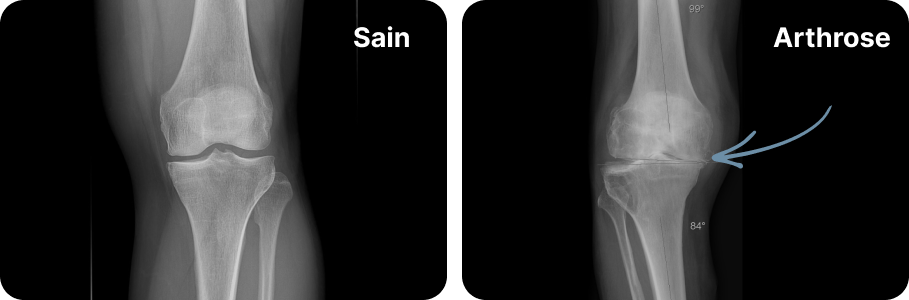
The main reason for this procedure is mechanical wear of the knee, also known as knee osteoarthritis. Inflammatory rheumatism, bone necrosis, an old fracture, or advanced ligament rupture are also frequent causes of wear leading to the placement of a prosthesis. The indication is justified when the medical treatment recommended as a first-line approach to reduce discomfort and pain is no longer effective.
Thus, 30 % of the people aged 60 to 70 are affected by gonarthrosis. Gonarthrosis indeed causes joint pain, swelling, and progressive deterioration. This figure increases to % 50 for people over 80. Autonomy and quality of life are affected.
Knee osteoarthritis is favored by deformities of the lower limbs («cowboy» or «X»-shaped knees: genu varum or genu valgum) but also by excess weight or past trauma such as fractures or severe sprains.
What does the operation consist of?
Surgery is performed under general or spinal anesthesia and lasts between one and two hours. Biological, radiological, dental, and urinary assessments are prescribed prior to the operation to confirm the diagnosis and verify the absence of an intercurrent infection.
The approach to the knee is vertical from the front. The bone ends are cut geometrically using instrumentation that is adjustable to each morphology. The implants are fixed with or without cement (unlike the hip, neither of the 2 methods has shown superiority).
The femoral component is made of cobalt-chromium or titanium, while the tibial component is most often made of titanium, to which a synthetic plastic (polyethylene) plateau is attached. This allows the new joint surfaces to glide properly, hence the generic term "sliding prosthesis." The prosthesis then functions thanks to the muscles of the thigh and lower leg; the peripheral ligamentous apparatus of the knee and the extensor mechanism (quadriceps tendon, patella, and patellar tendon) are preserved, but the cruciate ligaments, if not already damaged by knee osteoarthritis, are resected, and the design of the implants ensures the stability of the knee.
In cases where joint degradation is very severe, the surgeon may choose to use a so-called «hinged» prosthesis (a fixed axis connecting the femoral and tibial components).
To straighten the leg deformed by osteoarthritis, the instrumentation used during the procedure (ancillary) makes it possible to adapt the bone cuts to the prior geometric calculation, sometimes aided by computers (computer-assisted surgery, preoperative cutting guides, navigation with a dedicated smartphone, or finally a robot).
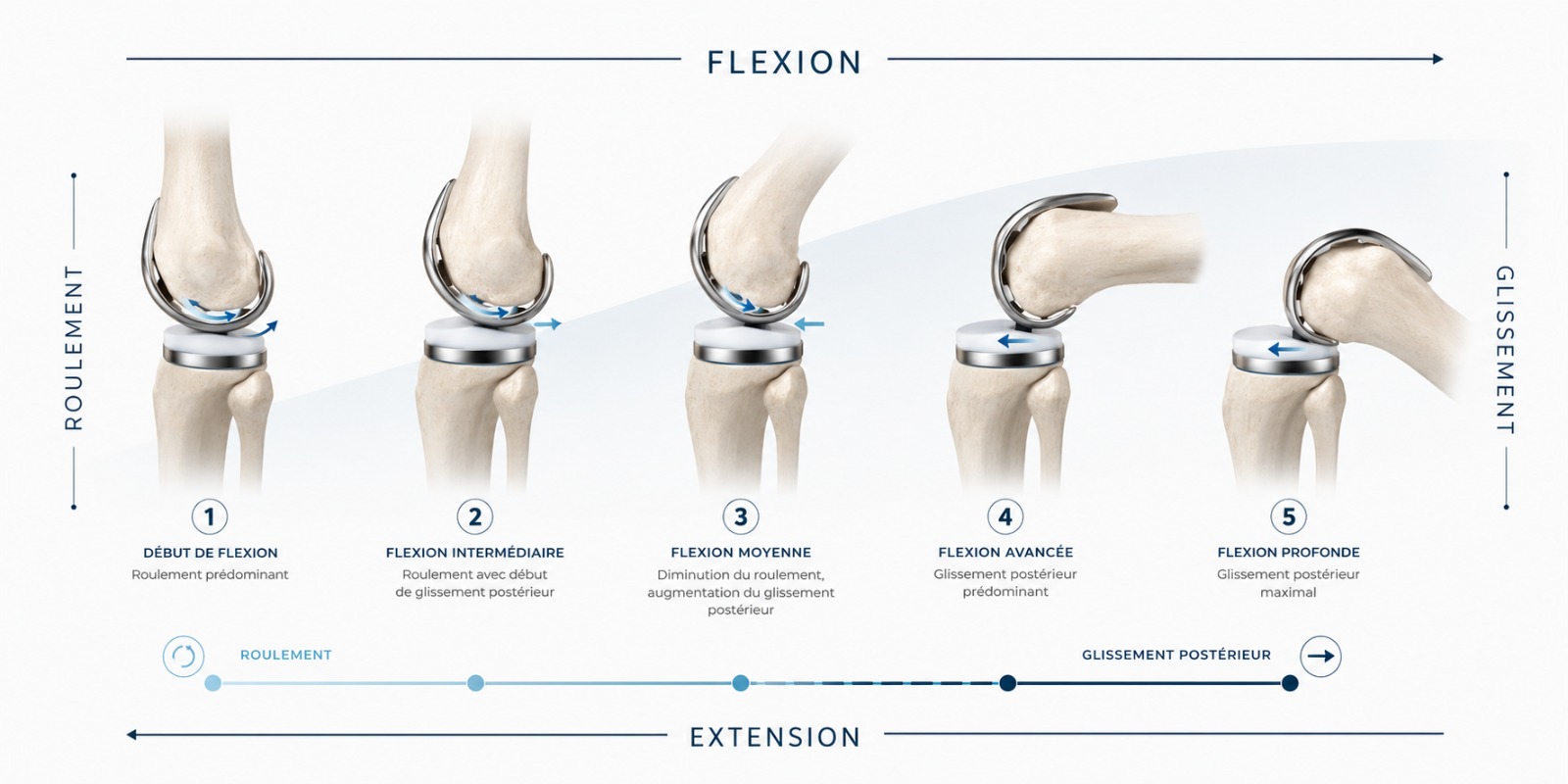
Principles of rolling and sliding of a total knee arthroplasty
Mandatory instructions before surgery
To guarantee the success of the procedure and minimize the risk of infection as much as possible, certain strict instructions must be followed before you are admitted to the hospital:
Smoking cessation
Since smoking massively increases the risks of infection and delayed healing, patients are strictly required to stop smoking at least one month before the procedure and for the three months that follow.
Skin preparation
The day before and the morning of the procedure, you must take a shower using an antiseptic or disinfectant soap. Please note that shaving the knee is not recommended; if hair removal is necessary, it must be done with hair clippers or a depilatory cream to avoid any micro-cuts.
Reporting allergies
You must absolutely inform your surgeon and the anesthesiologist if you have allergies to antibiotics, as well as to metals (such as nickel, chromium, or cobalt) if you have ever reacted to contact with jewelry, a watch, or a belt buckle.
How does the postoperative period go?
Knee rehabilitation involves the resumption of walking on day zero and passive and active mobilization of the joint to regain good range of motion. It begins with the help of two crutches or even a walking frame.
The duration of hospitalization varies depending on the context and the patient’s profile: outpatient, 2 days or more if necessary. A stay in a rehabilitation center is justified if living conditions or the general state of the patient do not allow a return to home. The prosthesis has a lifespan that can vary depending on the patient and their activity, but is often longer than 20 years. In the long term, it can wear out and peel off, requiring replacement. In order to monitor the evolution, an annual or biannual clinical and radiological follow-up is necessary.
Post-operative timeline
These timeframes are estimated and may vary. Your surgeon will provide more precise information during your consultation.
Day of the procedure
Stand up and bear weight on the limb with 2 crutches.
The very next day
The knee is placed in a rehabilitation machine allowing flexion, and rehabilitation for walking and stair climbing is provided. Discharge to home or a rehabilitation center is organized, along with the necessary prescriptions for care (dressings, analgesics, anticoagulants, physical therapy).
Within 4 to 8 weeks
Removal of stitches around day 15
Discontinuation of anticoagulant therapy and wearing of compression stockings 35 days post-surgery
Gradual weaning off crutches starting from the second week. Continuation of physical therapy.
Resumption of professional activity (depending on the occupation) and driving (if walking without a cane or easily with a single one).
For 2 to 4 months
End of rehabilitation and resumption of usual and then sporting activities (protecting the prosthesis against impacts or repeated trauma).
Between 6 months and 1 year
Continued functional improvement. The goal is to achieve comfortable and autonomous walking, with as complete a recovery of habitual activities as possible. In some patients, the prosthesis may become barely noticeable in everyday life.
Every 2 to 3 years
Follow-up visit with prosthesis X-rays.
The pre-operative sheet
Any surgery carries the risk of difficulties or complications which, even if uncommon, must be known and taken into account in the surgical decision. Please click below to read the information corresponding to the procedure described above.
Total knee replacement