Knee replacement revision
Knee replacement revision consists of replacing all or part of a previously implanted prosthesis when it no longer functions properly.
This surgery may be necessary early on or after many years after the initial implantation, even though the lifespan of a knee prosthesis can often exceed 20 to 25 years.
The objective is to eliminate pain, restore joint stability, ensure the bone fixation of the implants, and allow the patient to regain satisfactory mobility.
Knee replacement revision
Knee replacement revision consists of replacing all or part of a previously implanted prosthesis when it no longer functions properly.
This surgery may be necessary early on or after many years after the initial implantation, even though the lifespan of a knee prosthesis can often exceed 20 to 25 years.
The objective is to restore indolence and the joint stability at the maximum possible and thus of allow the patient to regain satisfactory mobility.

When is knee replacement revision necessary?
Several situations may lead to considering a takeover surgical.
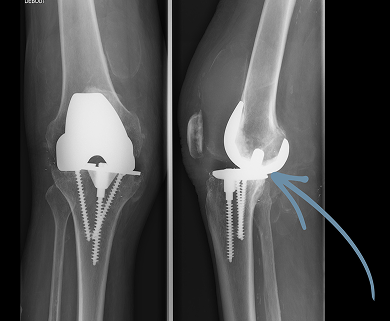
Due to wear of the prosthetic components
Over time, certain components, particularly the polyethylene insert, can wear out. This wear can lead to local inflammation, bone loss around the implants leading to their loosening, and impaired joint function.
Due to a detachment of the prosthesis
Loosening corresponds to a loss of fixation between the implant and the bone. It is the most common cause for revision. It most frequently manifests as pain when walking, a progressive decrease in functional capacity, or a feeling of instability.
Due to an infection of the prosthesis
An infection can occur early after the procedure or several years later. This situation requires specific management in conjunction with infectious disease specialists and sometimes several surgical interventions.
Due to instability of the knee
Ligament degeneration or poor joint balance can cause a sensation of the knee «giving out» or lacking stability during movement.
Due to a fracture around the prosthesis
Certain fractures occurring near the implants may require partial or complete replacement of the prosthesis.
Special case: Unicompartmental knee replacement revision
For a partial (unicompartmental) prosthesis, its replacement with a total prosthesis may be motivated by the classic causes of wear or infection.
However, two situations specific to this type of implant can also lead to a revision:
The evolution of osteoarthritis
Over time, osteoarthritis can naturally spread and develop in the other unoperated compartments of the knee, thus requiring a transition to a total knee replacement.
The ligament tear
An injury or rupture of the peripheral or central ligaments of the knee can destabilize the existing partial prosthesis and justify its replacement.
How is the diagnosis established?
The diagnosis is based on a specialized consultation combining a clinical examination and radiographic assessment.
X-rays make it possible to evaluate the position of the implants, their fixation, as well as the condition of the surrounding bone. Depending on the case, additional examinations may be prescribed:
- scanner ;
- biological tests ;
- joint aspiration ;
- bone scan.
These examinations help determine the origin of the pain and prepare the surgical strategy by establishing a body of evidence supporting a diagnosis.
How does the pre-operative care take place?
In addition to the aforementioned examinations, a complete preoperative workup is performed in order to prepare for the procedure under the best possible conditions. It generally includes an anesthesia consultation, laboratory tests, and any other specialized consultation deemed necessary.
In case of suspected infection, additional tests such as joint aspiration or specific analyses may be prescribed. These elements allow the surgeon and the infectious disease specialist to define the surgical strategy best suited to each situation.
What does the procedure involve?
The procedure is performed under general or loco-regional anesthesia and generally takes longer than an initial joint replacement. It involves removing the existing prosthesis, totally or partially, and then preparing the bone surfaces to implant a new prosthesis adapted to the situation.
Mandatory instructions before surgery
To guarantee the success of the procedure and minimize the risk of infection as much as possible, certain strict instructions must be followed before you are admitted to the hospital:
Smoking cessation
Since smoking massively increases the risks of infection and delayed healing, patients are strictly required to stop smoking at least one month before the procedure and for the three months that follow.
Skin preparation
The day before and the morning of the procedure, you must take a shower using an antiseptic or disinfectant soap. Please note that shaving the knee is not recommended; if hair removal is necessary, it must be done with hair clippers or a depilatory cream to avoid any micro-cuts.
Reporting allergies
You must absolutely inform your surgeon and the anesthesiologist if you have allergies to antibiotics, as well as to metals (such as nickel, chromium, or cobalt) if you have ever reacted to contact with jewelry, a watch, or a belt buckle.
Postoperative course and results
The postoperative course is generally longer and more gradual than for a first replacement. Rehabilitation begins shortly after the procedure, with a resumption of walking supervised by a physical therapist.
On average, it is possible to resume driving after one to two months. A return to professional activity is typically considered after two to three months, a timeframe that remains highly variable depending on the nature of the job. Finally, patience is essential: while progress is steady, optimal results and a clear improvement in knee function are truly observed starting from the 6th month post-operatively.
The goal is to restore a pain-free, stable, and functional joint, allowing the resumption of daily activities.
The pre-operative notes
Any surgery carries the risk of difficulties or complications which, even if uncommon, must be known and taken into account in the surgical decision. Please click below to read the information corresponding to the procedures described above.
Total knee arthroplasty revision
Revision of unicompartmental knee arthroplasty to total knee arthroplasty